
Muse Spark Open Hosting: 42B Active Is Not 42B Stored
Meta's 15 October open-weight release needs a capacity check. Separate active parameters, checkpoint size and runtime memory before choosing infrastructure.
The short answer
Muse Spark Open has 816 billion total parameters and 42 billion active per token. Active parameters describe computation, not the complete storage footprint. Check the actual weight format, supported runtime, context cache, deployment headroom and licence before self-hosting.

Reading options
On this page
- What changed on 15 October?
- Why 42B active does not mean 42B stored
- Three different numbers: theoretical bytes, checkpoint, runtime
- Choose a deployment path before copying a command
- A useful first pilot: a proposed, unexecuted exercise
- Costs and licence checks that remain yours
- Reader questions
- Sources & further reading
Before you start
Python 3 for the optional arithmetic-only demo. No model download, credentials or hardware purchase is needed for that calculation. The Mac/GPU deployment recipes and proposed agent pilot were not executed. Review current upstream requirements and licence terms before an authorized isolated evaluation.
Direct answer: Muse Spark Open, released on 15 October 2026, has 816 billion total parameters and 42 billion active per token. The active count describes sparse computation, not a 42-billion-parameter storage footprint. Before self-hosting, choose the actual checkpoint, verify a supported runtime and budget for weights, context cache and operating headroom separately.
For a developer running an agency website or a small hosting business, the important question is not whether an impressive model can run on a desktop somewhere. It is whether a specific deployment can finish your workload within its memory, privacy and cost boundaries.
Here is a practical way to read this launch without turning a parameter count into a hardware promise.
What changed on 15 October?
Meta's announcement and the released model card identify 15 October as the release date. This article was researched on 16 October in Dubai; it is not presenting an older Muse announcement as today's event.
The release makes model weights available, alongside launch-day inference integrations. The official collection lists BF16 and NVFP4 checkpoints. The model accepts multimodal input and produces text, with a stated context window of up to one million tokens. Those are published capabilities, not results reproduced by Hostlelo.
The practical innovation is the combination of sparse model execution, downloadable weights and several deployment paths. That creates more choices about where inference runs. It does not make every choice equally small, cheap or easy to operate.
Why 42B active does not mean 42B stored
Muse Spark Open is a mixture-of-experts model. In simple terms, a router selects a subset of expert computation for each token instead of running every expert each time. The larger collection of experts still belongs to the model.
Think of a workshop: using a few tools for one job does not mean the entire workshop has disappeared. Likewise, sparse activation can reduce work per token without shrinking the complete checkpoint to the active parameter count. How weights are placed across accelerators, host memory or storage depends on the runtime and deployment strategy.
The model card describes 256 experts with eight selected per token. This helps explain the mechanism; it is not a shortcut for estimating tokens per second or memory use on your machine.
Our AI-agent hosting architecture guide separates the application, model and permissions. This article adds a model-specific capacity check before you buy or allocate infrastructure.
Three different numbers: theoretical bytes, checkpoint, runtime
A useful arithmetic check starts with all 816 billion parameters:
ideal weight bytes = total parameters × uniform bits per parameter ÷ 8
If every parameter used exactly four bits, this would be 408 GB, approximately 379.980 GiB. At sixteen bits it would be 1,632 GB, approximately 1,519.918 GiB. GB uses powers of 1,000; GiB uses powers of 1,024.
These are deliberately simplified calculations, not measured download sizes or minimum RAM requirements. They exclude mixed precision, quantization metadata, runtime allocations, context cache and any additional models.
Crucially, Meta's developer launch guide describes the released NVFP4 checkpoint as approximately 530 GB, with only the experts quantized. Calling it a four-bit checkpoint does not mean every stored tensor consumes exactly four bits.
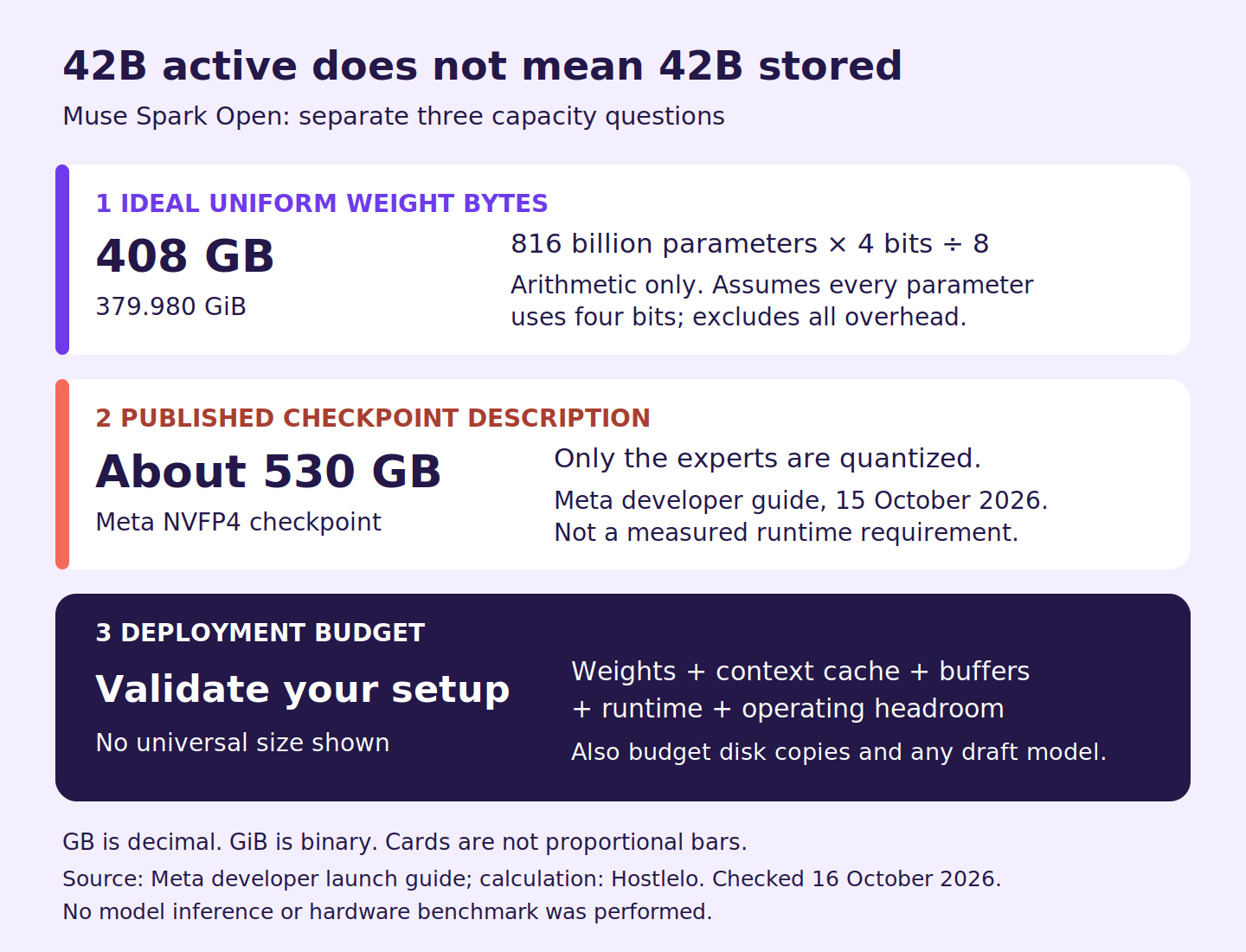
*The calculation is our arithmetic. The approximate checkpoint figure is Meta's published description. Actual runtime capacity must be validated on the chosen configuration; the cards are not proportional bars.*
Do not subtract a checkpoint size from a machine's advertised memory and assume the remainder safely supports a million-token prompt. Start with a short, representative workload and observe the actual allocations. Increase context and concurrency independently so you can identify which change exhausts capacity.
Reproduce the arithmetic without downloading a model
This Python 3 example performs local arithmetic only. Save it as weight_floor.py:
#!/usr/bin/env python3
"""Ideal uniform weight bytes only; not a runtime memory estimator."""
from decimal import Decimal, InvalidOperation


def weight_bytes(total_billions, bits):
    if isinstance(total_billions, bool):
        raise ValueError("parameter count must be a positive finite number")
    try:
        count = Decimal(str(total_billions))
    except InvalidOperation as exc:
        raise ValueError("invalid parameter count") from exc
    if not count.is_finite() or count <= 0:
        raise ValueError("parameter count must be a positive finite number")
    if type(bits) is not int or bits not in (4, 8, 16):
        raise ValueError("bits must be 4, 8 or 16")
    return count * Decimal(1_000_000_000) * bits / 8


if __name__ == "__main__":
    for bits in (4, 8, 16):
        size = weight_bytes("816", bits)
        print(f"{bits:2d}-bit ideal: {size / Decimal(10**9):.3f} GB; "
              f"{size / Decimal(2**30):.3f} GiB")
Run python3 weight_floor.py. The first line should be:
4-bit ideal: 408.000 GB; 379.980 GiBWe executed the arithmetic and tested the reusable function and companion command-line checker locally on 16 October. Ten unit tests passed, including unit conversion and rejection of invalid inputs. This verifies our calculator, not Muse Spark Open, its quantization quality or any inference engine. The companion CLI and tests use the same arithmetic function.
Choose a deployment path before copying a command
There are materially different starting points:
- Hosted evaluation: a provider runs inference. Together AI and Modal announced availability on 15 October. Provider access is not local inference; check retention, region, limits and current billing before submitting private material.
- Apple setup: Meta's Mac cookbook specifies two M5 Ultra Mac Studios with 512 GB each, or four with 256 GB each, plus Thunderbolt networking. It lists macOS 26.2 or later and MLX 0.30.1 or later. This is a multi-machine recipe, not a claim that an ordinary laptop can load the released checkpoint.
- GPU serving: use the recipe for the exact format and hardware. The vLLM recipe advertises 0.33.0+ but also tells readers to use its Docker image while support reaches the main repository. That qualification matters more than a generic installation command.
These are upstream-documented paths, not installations tested here. Pin the checkpoint revision, runtime image digest and configuration used in your pilot. Confirm the parser and input modalities on that specific backend; model-level support does not establish identical behavior across serving stacks. For example, the vLLM recipe labels its AMD commands text-only.
The Mac cookbook also requires disk space for the full NVFP4 checkpoint on each Mac. Dividing runtime weights between machines does not automatically divide every on-disk copy. Include downloads and staging space in the procurement note.
For smaller private-model deployments, our Ollama VPS guide covers keeping an API private. It is not a statement that a modest VPS can host this model.
A useful first pilot: a proposed, unexecuted exercise
Before connecting production tools, try a disposable website repository with one deliberately failing test. Use invented content and no credentials.
- Write the expected fix and acceptance checks before the agent starts. Keep the test outside the agent's editable scope where practical.
- Ask for a patch, not a deployment. Disable network and external writes unless explicitly needed and approved for this isolated exercise.
- Review the diff and run the existing test suite independently. Reject changes that merely remove the test or weaken its assertion.
- Record the exact model format, reasoning setting, context limit, wall-clock time, errors and observed resource use. For a hosted endpoint, also retain actual usage records.
- Repeat with a few representative tasks before increasing context or concurrency. Stop on an unexplained failure, unexpected tool destination or resource pressure affecting other workloads.
This pilot is an author-proposed evaluation, not a published benchmark. A good answer to one prompt does not prove safe autonomous operation. Our website-agent access checklist covers the separate permission boundary.
Costs and licence checks that remain yours
Downloading weights is not a zero-cost deployment. Compare hardware allocation, storage replicas, power, networking and operator time with the hosted service's actual metered use. Include failed attempts and recovery work in your internal comparison. No hardware price, API tariff or break-even point was established for this article.
The Muse Model License has attribution and Usage Policy obligations, plus additional terms for qualifying Model-as-a-Service businesses. It is not an MIT or Apache licence merely because the weights are available. Read the complete terms for your intended activity and seek appropriate advice; this is a licence-review flag, not legal clearance.
Meta's model card recommends system-level safeguards and acknowledges inaccurate outputs and other limitations. Vendor safety and performance results are not a certification of your agent, tools or deployment. We did not load the model, reproduce Meta's benchmarks, validate any vendor throughput claim or test the Mac or GPU recipes.
The sensible next step is a bounded evaluation with a recorded configuration. Buy infrastructure only after separating what is active, what is stored and what the complete workload actually needs.
Reader questions
Can a 42B-capacity server host Muse Spark Open because only 42B parameters are active?
Do not size storage or memory from the active count. The complete model has a much larger collection of weights. Check the exact checkpoint, placement strategy, context cache and runtime allocations for your configuration.
Is the released NVFP4 checkpoint exactly 408 GB?
No. 408 GB is our simplified calculation if every one of 816 billion parameters used four bits. Meta describes the actual NVFP4 checkpoint as approximately 530 GB, with only experts quantized. Neither figure is a measured runtime memory requirement.
Does the Mac deployment use just one ordinary desktop?
No. Meta's cited cookbook uses two or four specifically configured Mac Studios, with networking and software prerequisites. It also requires a full local checkpoint copy on each machine. Consult the current cookbook before allocating hardware.
Does a one-million-token context window guarantee that my workload will fit?
No. It is a model capability, not a capacity guarantee for every serving configuration. Test representative input and concurrency on the selected backend and observe cache and runtime memory use.
Is open-weight the same as unrestricted commercial use?
No. The Muse Model License includes attribution, Usage Policy and other conditions. Review its complete terms for your intended use; this article does not provide legal clearance or summarize every obligation.
What did Hostlelo actually test?
We ran the local weight arithmetic and ten unit tests for the calculator and companion CLI. We did not load Muse Spark Open, test a hosted model API, deploy the Mac/GPU recipes or reproduce vendor benchmarks. The pilot is proposed guidance.
Was this guide helpful?
Help us make the next update better.
Sources & further reading
- Meta research announcement, 15 October 2026
- Muse Spark Open model card
- Official checkpoint collection
- Meta developer launch guide and format descriptions
- Meta Mac deployment cookbook
- vLLM model recipe, updated 15 October 2026
- Muse Model License and Usage Policy
- Together AI launch-day availability
- Modal launch-day availability
Originally published . About our editorial updates.