Cloud VPS for AI Agents:Separate the App, Model and Permissions
Plan AI-agent hosting by separating orchestration, model inference, data and tools. Evaluate CPU versus GPU needs, retries, permissions and operating cost.

On this page
The short answer
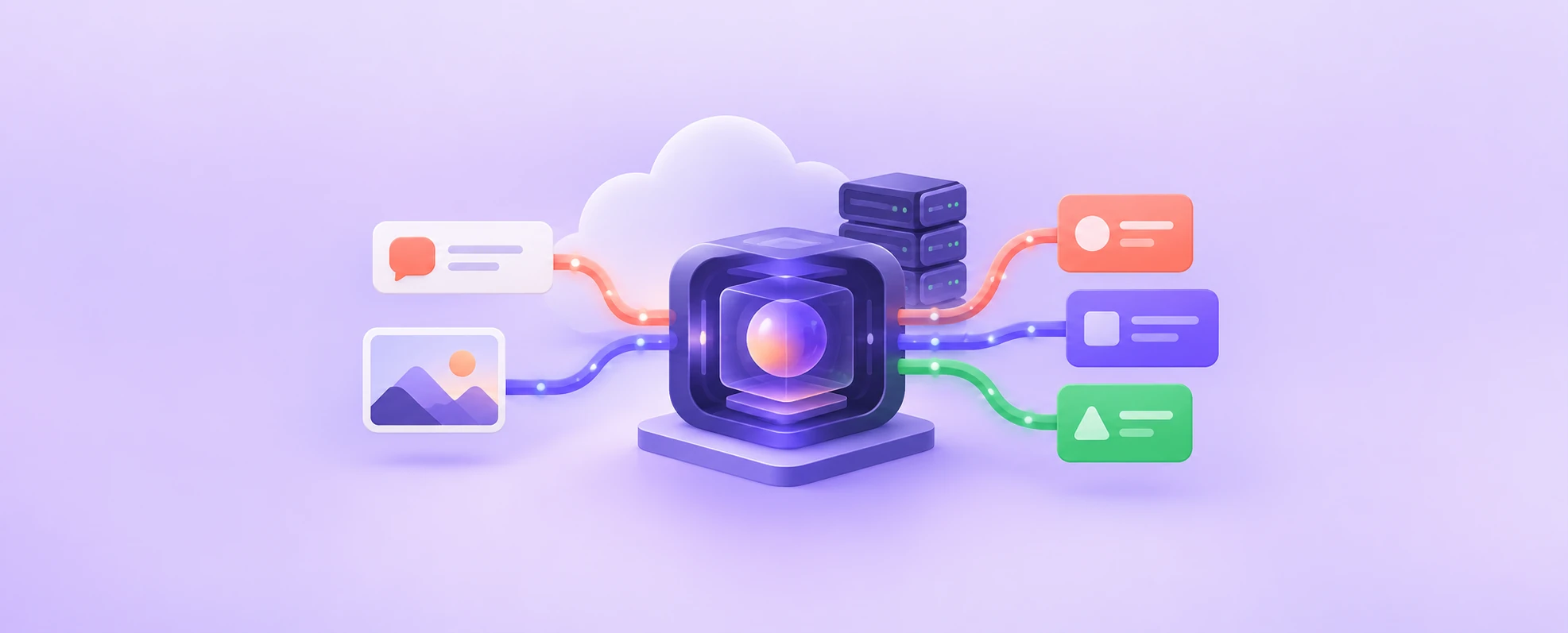
A cloud VPS can host the application, tools and background workers of an AI agent while the language model runs through an external API. Running the model on that VPS is a separate hardware decision. Start by separating orchestration, model inference, business data and actions; then size and secure each part according to its job.
Before you start
Identify the agent’s tools, data flows and consequential actions. The architecture is proposed guidance, not a tested reference deployment.
An agent that drafts a support reply needs a different deployment from an agent that can issue refunds or change DNS. The important question is not simply whether the server can run Python. It is what the application is allowed to do when its output is wrong.
For the broader distinction between provider automation and your own application, see our AI-powered hosting explainer. This guide focuses on placing the components of the application you operate.
Decide where the model runs
Deployment | What the VPS does | Main constraint to evaluate |
|---|---|---|
External model API | Runs the application, tools, queue and integrations | API cost, latency, provider availability and data handling |
Local CPU model | Also performs inference on its CPUs | Memory fit, response time and concurrency |
Local GPU model | Performs inference using an available compatible GPU | VRAM, driver support and hardware cost |
Hybrid | Routes selected requests between local and external models | Clear routing rules, privacy boundaries and failure handling |
AMD EPYC is a CPU brand, not a GPU allocation. Root access or an AI-related product label does not mean a server has the hardware needed for your chosen model. For local inference, use our Ollama VPS guide and the actual model's requirements.
Design permissions before adding tools
Consider an illustrative support assistant. It can read a ticket, retrieve approved documentation and propose a reply. A separate, authenticated service decides whether any account change is permitted.
Give each integration only the access it needs. A read-only billing credential should not share a secret with a provisioning administrator. Keep credentials out of prompts, repository files and browser code. Record which tool was called, which resource it addressed and whether it succeeded, while redacting confidential payloads.
Treat retrieved websites and uploaded files as untrusted content. Their text can inform an answer; it should not become permission to execute a command. A tool service should validate identifiers, actions and authorization independently of the model's wording.
Use a small deployment with clear boundaries
A practical starting design has an HTTPS entry point, an application service, a background worker, a database and a narrowly scoped tool service. Keep database and worker interfaces on private networks. Add a queue when jobs need retries or can outlast an HTTP request.
This is an author-proposed architecture, not a Hostlelo product specification or a measured reference deployment. A single VPS can run its components for a small pilot, but it remains a shared failure domain. A container restart policy does not make the database highly available.
For workflow-oriented automation, n8n on a VPS may be more approachable than a custom application. Its licensing and operational requirements still apply.
Put boundaries on cost and retries
Set a maximum number of model/tool calls per job, a time limit and a budget threshold. Limit retries for failed actions and use a stable operation identifier when a downstream API supports idempotency.
For example, retrying a document lookup may be harmless; retrying an invoice charge can create a serious accounting problem. Design those paths separately. A timeout does not prove that the remote action failed before completion.
Estimate monthly cost as server and storage charges, backups, monitoring, model usage, external APIs and operator time. Do not compare a VPS rental alone with a managed AI service that includes different responsibilities. There is no meaningful universal "cost per agent" without a workload definition.
Size from a representative job
Run a pilot with non-sensitive sample data and record peak memory, processing time, simultaneous jobs, database growth and error rates. Include failed and retried jobs. A long-running import or a large document can matter more than a typical short chat.
Set a target that reflects the business: for example, an internal draft may tolerate waiting, while a live customer conversation may not. These are acceptance criteria you choose, not latency claims about a hosting plan.
If using n8n queue mode, its official design separates workers and uses Redis with database access. Adding workers creates dependencies to operate; it does not remove the need for backups or capacity planning.
Prepare for the wrong answer and the failed server
Before production, verify that a job can stop safely, a tool credential can be revoked, and a failed workflow can be investigated without replaying a payment or deleting data. Require approval for consequential actions until the system has a justified, tested authorization design.
Back up business state and configuration, store secrets through an appropriate protected process, and test recovery. Monitor both service health and a representative end-to-end job. A responding homepage does not prove the worker is processing tasks.
Hostlelo's Cloud VPS page is a place to evaluate infrastructure options. Confirm the specific region, resources, management scope and any accelerator allocation before ordering. No throughput, autonomous capability or GPU availability is promised by this article.
Reader questions
Do AI agents need a GPU server?
Not when the model runs through an external API. A GPU becomes relevant when you choose local inference and the model and workload benefit from compatible hardware.
Can one VPS run several agents?
It may, but capacity depends on simultaneous work, memory use and tool behavior. Use a representative pilot and limits rather than a fixed agents-per-server claim.
Is self-hosting automatically more private?
No. External model calls, telemetry, logs, backups and integrations can still carry data elsewhere. Map each data flow and verify the relevant settings and agreements.
Sources & further reading
Originally published . About our editorial updates.