
Hermes Agent 0.22.2: Local AI Needs a Release Check
Hermes v0.22.2 was a historical corrective release; v0.22.5 is latest as of 25 October. Review the known limitation, current release channel, gateway and local-model evidence before a pilot.
The short answer
Hermes Agent v0.22.2 was the 15 October 2026 corrective release; GitHub lists v0.22.5 as latest as of 25 October. This retrospective explains the 0.22.2 gateway/local-model changes and known session limitation. Check the current release for your installation channel, verify the actual running gateway and inference endpoint, then test a synthetic task before connecting business workflows.

Reading options
On this page
- What happened on 15 October, and what was already announced?
- How managed local inference works
- Why the gateway fix is more than a restart button
- Start with a release receipt, not an update command
- A small-business pilot with an observable finish line
- Costs and deployment limits to measure
- What this release does not establish
- Reader questions
- Sources & further reading
Before you start
Python 3 for the optional release-metadata example; it reads public GitHub data and requires no account or API key. Hermes checks and restart/sleep drills are unexecuted guidance for an authorized isolated test account or VM. Preserve existing application state and do not use production credentials or live customer workflows.
Direct answer: Hermes Agent v0.22.2 was the 15 October 2026 corrective release for v0.22.1. As of 25 October, GitHub lists v0.22.5 as the latest release, so this article is a retrospective on v0.22.2, not a recommendation to install it as the newest build. Before piloting the 0.22 local-AI workflow, check the latest release for your installation channel, running gateway and model endpoint separately. A matching version label does not establish that a business task completed safely.
The useful innovation in the 0.22 line is reduced setup work around local inference: an agent interface can manage a llama.cpp runtime and model downloads instead of asking every user to assemble the stack. That corrective patch makes an operational lesson especially clear: easier installation does not remove the need to know what is running.
What happened on 15 October, and what was already announced?
The official v0.22.2 release says v0.22.1 was built from the wrong commit, included unreleased gateway work and could leave the Microsoft Store app stuck on Connecting. It presents v0.22.2 as the intended corrective build. Subsequent release notes date v0.22.3 and v0.22.4 to 21 October and v0.22.5 to 22 October. GitHub displays publication of v0.22.5 on 23 October at 05:28; a release-note date is not necessarily its publication timestamp. This article continues to document what .22.2 changed; it does not establish whether later builds resolved every .22.2 limitation.
Keep the dates separate:
- v0.22.0: its release notes label it 13 October. GitHub records publication at 03:21:46 UTC on 14 October, or 07:21:46 in Dubai.
- v0.22.1: GitHub publication was 23:59:24 UTC on 14 October, or 03:59:24 on 15 October in Dubai.
- v0.22.2: GitHub publication was 08:21:32 UTC on 15 October, or 12:21:32 in Dubai.
The original 15 October article reported checking these timestamps through the repository's public release API. That historical request was not rerun or independently established from an archived receipt in this review. The local-model feature is not being presented as a brand-new invention today; the new event is the corrective release.
Known limitation in v0.22.2: its release notes say sessions that ran under the v0.22.1 gateway cannot be deleted in v0.22.2. The current release list does not by itself confirm whether later builds fixed that limitation. Preserve needed records and check current upstream guidance; do not treat deleting the data directory as a repair.
How managed local inference works
According to the Local Models guide, Hermes manages the inference engine, selects a hardware-appropriate model build and starts the local server. The desktop path is Settings → Providers → Local Models; the terminal path is hermes model, then Local models.
In plain terms, the agent is the coordinator, the model server produces model responses, and tools carry out allowed actions. Choosing a local model changes the inference path; it does not automatically change every tool's destination.
The 0.22.0 announcement also introduced hosted connectors through the Nous tool gateway. Therefore, a workflow that uses a local model and a hosted connector is not wholly offline. The inference component may stay on the machine while an allowed app operation still contacts a service.
For an initial pilot, our proposed boundary is narrower: synthetic input, the intended local endpoint and no business-app writes. Add each connector only after reviewing its account, permissions and data flow. The broader AI-agent website-access checklist covers credential scope; this article focuses on release and runtime evidence.
Why the gateway fix is more than a restart button
The gateway fix's pull request describes a process-identity problem after reboot. A saved gateway record could name a low process ID that Linux later assigned to an unrelated process. The supervisor could then refuse to start the real gateway because the old record appeared alive.
The fix adds boot-incarnation evidence and uses the host lock when the older record cannot establish ownership. The important distinction is identity, not simply whether some process has the same number.
This is an upstream diagnosis, not a reboot experiment performed by Hostlelo. Do not kill the process named by an old record, remove a lock blindly or start a second gateway to force progress. Capture the relevant diagnostics and use the release appropriate to your installation method.
The local-model fix addresses another layer: streaming progress while a prompt is being read, timeout accounting around sleep, and recovery when a local server becomes available again. Those are runtime-handling changes, not evidence that a particular model became more accurate or faster on your hardware.
There is an important qualification in that discussion: a maintainer says a fully sleep-aware compression clock was deferred. Explicit Windows sleep or lid closure can still cancel a summary on wake, with the turn continuing and compression retried later. Treat this as an upstream-described limitation, not a universal sleep-resilience guarantee.
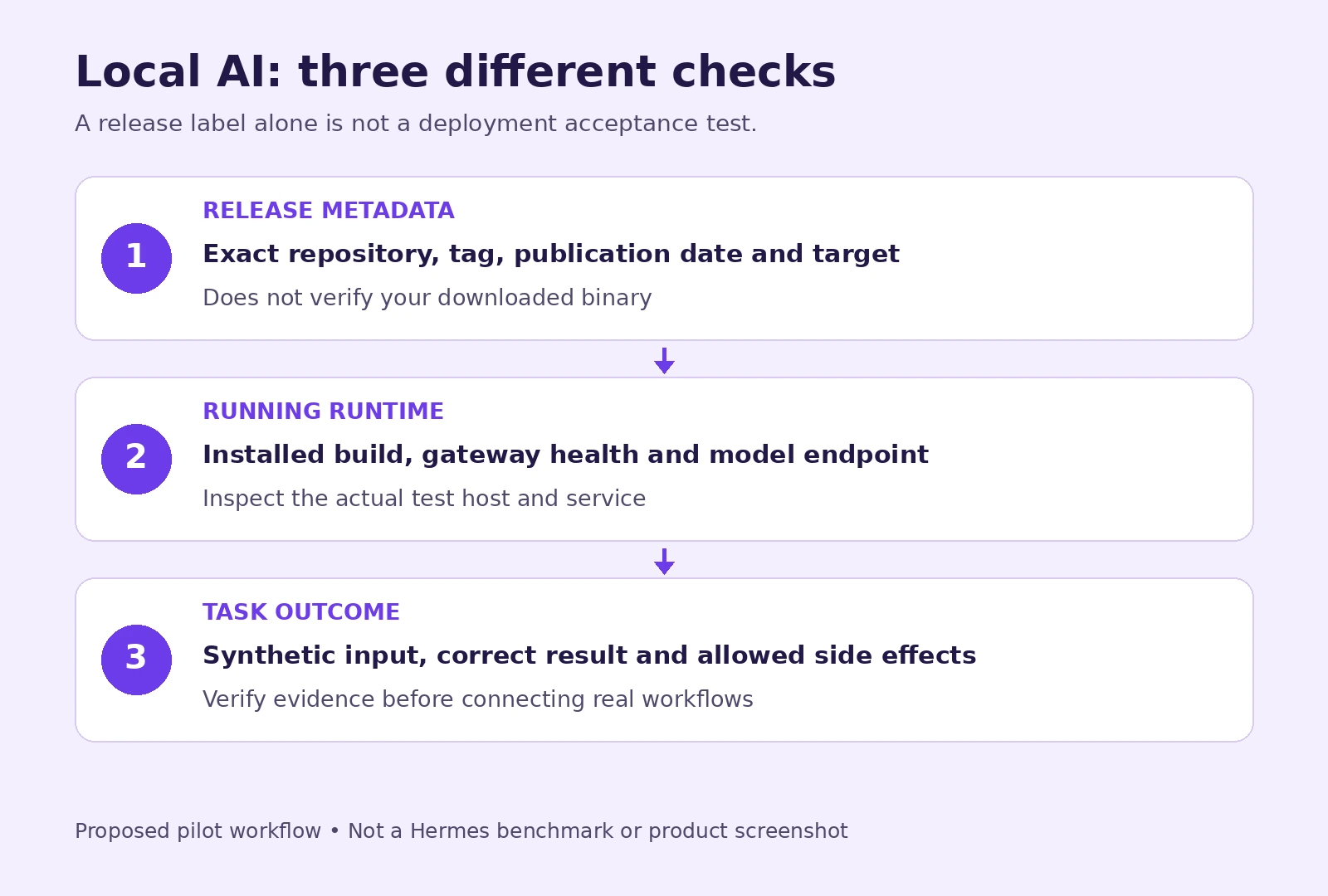
Author-proposed pilot workflow. Release metadata, runtime health and task completion are different evidence checks, not benchmark results.
Start with a release receipt, not an update command
Before a pilot, record the installation method, intended channel, release tag, model identity, quantization, runtime backend and approved tool set. Keep customer data and credentials out of that note.
The update guide distinguishes source installs from package-owned applications. Do not run source maintenance inside an installed desktop bundle or assume an operating-system package already contains today's GitHub release.
On an existing CLI installation, these are documented checks, not commands executed for this article:
hermes --version
hermes update --plan
hermes gateway status
Use the app's About information for a bundled desktop installation. Follow the package owner's update path when applicable. Treat unsupported flags on an older installation as a reason to consult that version's documentation, not as permission to improvise a repair.
For a source checkout, hermes update --check previews the selected channel's target without applying the update, but may fetch Git metadata. It is not a promise of zero network traffic or filesystem writes. No update is performed by the Python example below.
A reproducible, narrowly scoped metadata check
Save this as release_receipt.py. It uses the GitHub release-by-tag API, checks explicit non-draft/non-prerelease flags and prints a receipt. target_commitish is the API field name; in general it may name a branch rather than a resolved commit, so it is not a substitute for artifact verification.
#!/usr/bin/env python3
"""Read release metadata. Does not verify or update an installed application."""
import argparse
import json
import re
import sys
import urllib.request
from datetime import datetime
from pathlib import Path

REPO = "NousResearch/hermes-agent"


def validate_release(data, tag):
    if not isinstance(data, dict):
        raise ValueError("release response must be an object")
    if not re.fullmatch(r"v\d+\.\d+\.\d+", tag):
        raise ValueError("expected tag must be a stable vX.Y.Z tag")
    expected = f"https://github.com/{REPO}/releases/tag/{tag}"
    if data.get("html_url") != expected or data.get("tag_name") != tag:
        raise ValueError("repository or tag does not match")
    if data.get("draft") is not False or data.get("prerelease") is not False:
        raise ValueError("release must explicitly be public and non-prerelease")
    published = data.get("published_at")
    if not isinstance(published, str):
        raise ValueError("missing publication timestamp")
    try:
        stamp = datetime.fromisoformat(published.replace("Z", "+00:00"))
        if stamp.utcoffset() is None:
            raise ValueError("timestamp has no timezone")
    except ValueError as exc:
        raise ValueError("invalid publication timestamp") from exc
    target = data.get("target_commitish")
    if not isinstance(target, str) or not target.strip():
        raise ValueError("missing target_commitish")
    return {"repository": REPO, "tag": tag, "published_at": published,
            "target_commitish": target, "release_url": expected,
            "scope": "release metadata only; installed binary not verified"}


def main():
    parser = argparse.ArgumentParser(description=__doc__)
    parser.add_argument("--tag", required=True)
    parser.add_argument("--fixture", type=Path, help="read local JSON instead of networking")
    args = parser.parse_args()
    try:
        if not re.fullmatch(r"v\d+\.\d+\.\d+", args.tag):
            raise ValueError("expected tag must be a stable vX.Y.Z tag")
        if args.fixture:
            data = json.loads(args.fixture.read_text(encoding="utf-8"))
        else:
            url = f"https://api.github.com/repos/{REPO}/releases/tags/{args.tag}"
            request = urllib.request.Request(url, headers={
                "Accept": "application/vnd.github+json",
                "User-Agent": "Hostlelo-release-receipt/1.0"})
            with urllib.request.urlopen(request, timeout=20) as response:
                data = json.load(response)
        print(json.dumps(validate_release(data, args.tag), indent=2))
    except (ValueError, OSError) as exc:
        print(f"Release check failed: {exc}", file=sys.stderr)
        return 1
    return 0


if __name__ == "__main__":
    sys.exit(main())
Run the fixed-tag public check:
python3 release_receipt.py --tag v0.22.2The original article reported a 15 October metadata result of publication 2026-10-15T08:21:32Z and target d923a5eb487a17c0a68801bba9ef0f56c81040a8, plus 12 local checker tests covering input validation. Archived request receipts and the original test suite were not supplied for this review, so those historical executions are not independently verified here.
Such tests can validate the checker, not Hermes. The program does not inspect your installed executable, verify a downloaded package's signature or hash, contact your gateway, load a model, install dependencies or update anything. Public API failures and rate limits are errors, not evidence that your machine is current.
A small-business pilot with an observable finish line
Here is our proposed, unexecuted pilot, not a vendor benchmark:
- Use an isolated test account or VM, without production credentials or a shared live profile. Back up any existing state before testing a different build against it.
- Give the agent five invented hosting-support tickets. Ask it to classify each ticket and draft a summary. No email sending, DNS changes, shell repairs or billing writes are allowed.
- Select the intended local model. Record the actual endpoint and whether any enabled tool contacts an external service. Do not infer privacy from a Local label alone.
- Check the answer against a small, human-written reference. Record wrong classifications, missing facts and unsupported claims, not just whether text appeared.
- On the disposable environment only, test the restart or sleep condition relevant to your deployment. Record gateway health and the next request's behavior. Do not reboot a production host for a blog checklist.
- Confirm the task's result before retrying it. A healthy model server or gateway does not prove that a previous external write did or did not occur.
If you later connect WordPress, use a separately scoped account and a draft-only exercise first. Our WordPress application-password guide explains access and revocation checks; it does not imply that every credential has per-key scopes.
Costs and deployment limits to measure
The repository is MIT-licensed, but a model's weights have their own license. Open-source application code does not establish commercial rights to every model you download.
Local inference still uses hardware, storage, electricity and operator time. Account for runtime and weight downloads, working memory, concurrent website workloads, logs and recovery storage. A model file fitting on disk is not a memory-capacity test. No current VPS/GPU price or hardware-speed benchmark was established here.
For a hosted model or connector, verify the service's current billing, limits and data handling independently. The desktop onboarding trial described in the 0.22.0 notes is not evidence of an unlimited free production service.
On a shared hosting server, resource isolation matters as much as model selection. Start away from customer workloads, constrain permissions and decide who owns upgrades and rollback. Our backup and test-restore guide explains the recovery principle; Hermes application state also needs its own appropriate backup.
What this release does not establish
We did not install Hermes, reproduce the gateway defect, run a local model, benchmark tokens per second or verify an offline deployment. The upstream fixes and feature descriptions are documented claims. The original article reported only a release-metadata request and checker tests; this review does not establish those historical executions or a tested Hermes deployment.
There is no basis here for claiming that all earlier installations fail, that all platforms received the same package simultaneously, or that every session problem is solved. Check the known limitation, actual running build and your own pilot evidence.
The practical decision is not simply local versus cloud. It is whether the exact release, running components and task result all have evidence you can inspect before giving the agent real business work.
Reader questions
What changed in Hermes Agent v0.22.2?
The 15 October release corrects a wrong-commit build in v0.22.1 and documents gateway-startup and local-model runtime fixes. It also retains a known limitation: sessions used by the v0.22.1 gateway cannot be deleted in v0.22.2.
Does selecting a local model make every Hermes tool offline?
No. A local model changes the inference path. Hosted connectors or other network tools can still contact external services. Review the actual endpoint and each enabled tool's destination before using private data.
Should I update every installation with the same command?
No. Identify the installation owner first. Source checkouts, desktop bundles, Store apps and container images have different update paths. Review the release and current installation guidance, then stage the change with recovery available.
Does the release-receipt checker verify my installed binary?
No. It checks a fixed repository's public release metadata. It does not inspect a local executable, validate package signatures or hashes, or prove that a running gateway uses that build.
Can I put a local model on an ordinary hosting server?
Do not assume capacity from the hosting label. Check provider permissions, working memory, storage, resource isolation and performance on representative synthetic input. No hosting-plan suitability or hardware-speed claim was tested here.
What did Hostlelo actually test?
The original article reported a GitHub metadata request and 12 local checker tests. Archived receipts and the original test suite were not supplied for this independent review, so those historical executions are not verified here. No Hermes installation, inference, reboot, sleep-recovery or production benchmark was performed by this review.
Was this guide helpful?
Help us make the next update better.
Sources & further reading
- Hermes Agent v0.22.2, 15 October 2026
- Hermes Agent v0.22.0 release notes
- Gateway boot-identity fix and limits
- Local-model runtime fix and deferred sleep-compression limitation
- Local Models documentation
- Updating and installation ownership
- Version-pinned update documentation, v0.22.2
- GitHub REST release-by-tag API
- Hermes Agent official repository and MIT license
- Hermes Agent current public releases (v0.22.5 latest as of 25 October 2026)
- Hermes Agent v0.22.5 release, dated 22 October 2026
Originally published . About our editorial updates.