Semi-OPD: What to Check Before Reusing AI Training Data
An October 8 preprint questions repeated online sampling. Here is a practical cache checklist, a tested local demo and a realistic pilot plan for small AI teams.
The short answer
Semi-OPD reuses initial student responses and fixed teacher scores while the student continues to learn. Before trying it, verify the exact model and tokenizer revisions, score alignment, cache integrity and an untouched evaluation set. The paper's results do not establish gains for your business task.

Reading options
On this page
- What is recent, and what the paper actually supports
- The mechanism in plain English
- Start with the information your training method needs
- Give the cache a contract
- Run a local fingerprint demo
- A proposed pilot for a hosting support assistant
- Budget the full experiment, including the cache
- Protect the data you are preserving
- When to pause
- Reader questions
- Sources & further reading
Before you start
Python 3 for the synthetic local demo. A real training pilot additionally needs an authorized dataset, compatible student/teacher tooling, aligned scoring, an evaluation set, reviewed licenses and a bounded compute budget.
A small AI team can spend its budget generating training answers, scoring them, and discovering later that the files no longer match the model or prompt configuration.
A recent distillation paper makes that operational problem worth examining. Its proposed method reuses an initial set of student responses. For a developer, the next question is practical: what must stay attached to those responses before you trust a cached training run?
This guide proposes a cache checklist and a local integrity demo. The checklist is our engineering recommendation. The demo checks synthetic data; it does not train an AI model.
What is recent, and what the paper actually supports
Siyan Zhao and colleagues posted When Do We Need On-Policy Distillation? Distilling on Offline Student Rollouts Is Often Better to arXiv on 8 October 2026 at 05:54 UTC, or 09:54 in Dubai. This article reviews it on 12 October. It is a recent preprint, not a paper released today.
The authors report Semi-OPD ahead of standard OPD in 14 of 17 teacher–student pairs. Their main evaluation uses competition-math tasks. That is research evidence for the evaluated settings, rather than proof of better customer support or cheaper production inference.
The existing Hostlelo guide to typed decision models concerns calling a model for bounded answers. This article concerns training data and model updates, a different stage of an AI system.
The mechanism in plain English
A student is the model being trained; a teacher supplies guidance. A rollout is a generated response.
Standard OPD repeatedly collects responses from the changing student and scores them with a fixed teacher. Semi-OPD collects responses once from the initial student and caches teacher scores. Training reuses that material while recomputing the current student's probabilities.
The paper links the relative benefit to initial teacher–student token overlap and notes that weak initial responses can hurt Semi-OPD. It is not a universal replacement for online sampling.
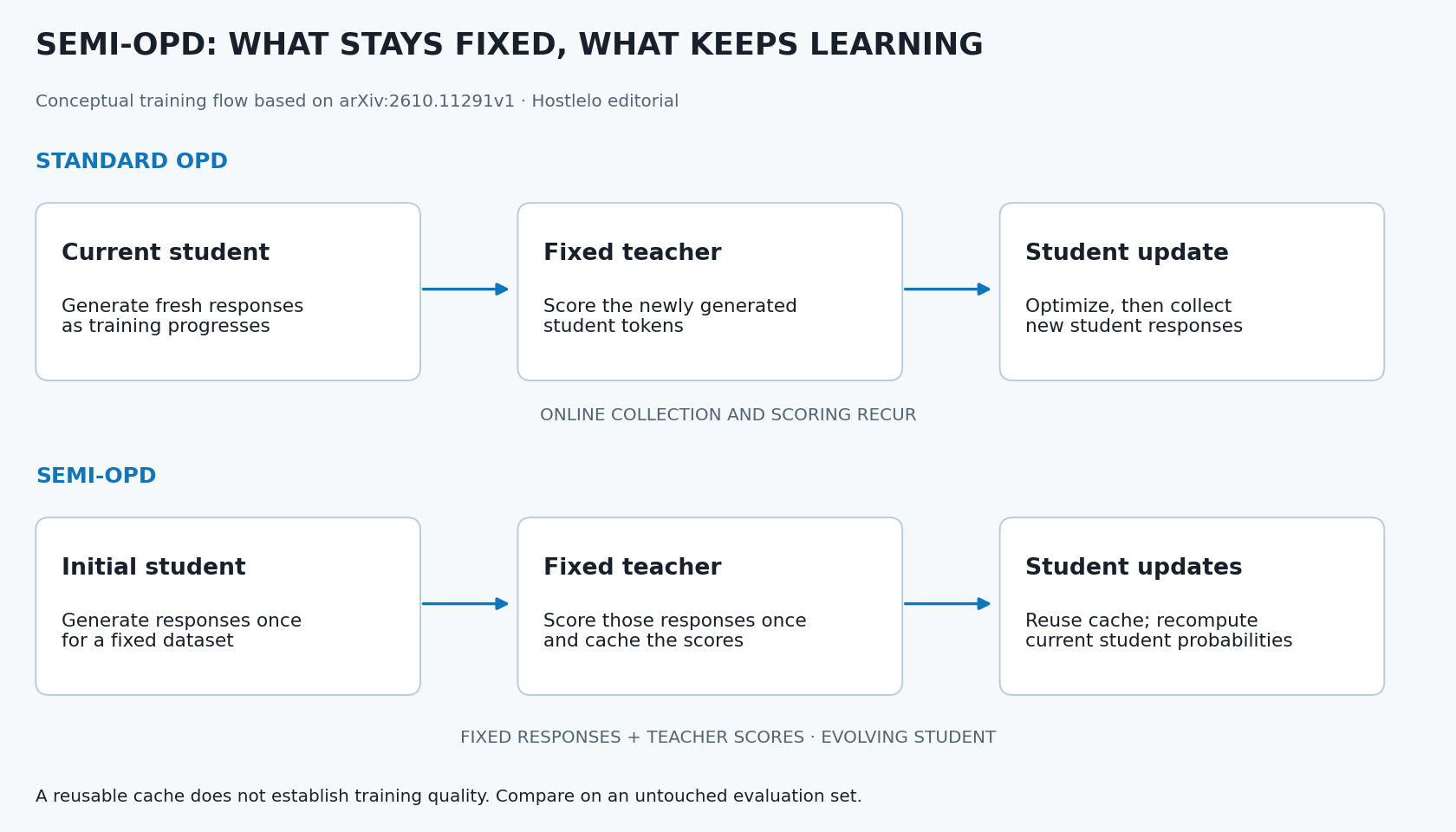
Our practical inference is modest: if you reuse a dataset, make its identity inspectable. A cache filename such as latest.json is not enough.
Start with the information your training method needs
A transcript of an answer and a scored training trajectory are different artifacts.
Transformers documents causal-language-model logits as per-position vocabulary scores before softmax. To build a usable scored cache, verify what your chosen method expects: token identities, score representation, sequence boundaries and masks.
Do not substitute a fluent teacher answer for token-level supervision without intentionally changing the method. Check whether a hosted API can score the exact student sequence, rather than only returning probabilities for tokens it generated itself.
Tokenizer compatibility is also a real implementation issue. NeMo RL's distillation API includes a vocabulary-equality check. Its separate cross-tokenizer guide describes a mapping-based route. The existence of that route does not make arbitrary token IDs interchangeable.
Before choosing a teacher, ask your training engineer to demonstrate one correctly aligned record end to end.
Give the cache a contract
For a proposed small-team pilot, keep a manifest beside each immutable dataset shard. Record:
- Exact initial-student, teacher and tokenizer revisions.
- The complete prompt/template identity and generation settings.
- Scoring configuration and the meaning of each stored score.
- Prompt/response boundaries, padding rules and loss masks.
- Dataset and shard digests, schema version and record counts.
- Collection date, software versions and the owner of the data.
Preserve the actual inputs these identifiers describe. A label saying “template-v3” is useful only if you can retrieve template-v3.
Do not quietly overwrite scores when changing the teacher. Create a new cache version, document why it changed, and compare results against the earlier version.
A cached score can be numerically valid yet attached to the wrong token. Add a small manually inspected fixture that checks token alignment and masking before submitting a long training job.
Run a local fingerprint demo
Save the following as cache_fingerprint_demo.py and run it with Python 3. We executed this exact example with Python 3.12.14.
It uses Python's JSON serializer and SHA-256 implementation. It requires no third-party packages, network calls, model weights or GPU.
Every token ID, model identifier and log-probability below is invented toy data. The code checks whether the combined configuration and records changed.
"""Synthetic cache-integrity demonstration. No model, inference or training."""
import copy
import hashlib
import json


def fingerprint(payload):
    blob = json.dumps(payload, sort_keys=True, separators=(",", ":"),
                      ensure_ascii=False, allow_nan=False).encode("utf-8")
    return hashlib.sha256(blob).hexdigest()


cache = {
    "configuration": {
        "initial_student_revision": "synthetic-student-v1",
        "teacher_revision": "synthetic-teacher-v1",
        "tokenizer_revision": "synthetic-shared-tokenizer-v1",
        "prompt_template_revision": "demo-template-v1",
        "scoring_configuration": "synthetic-log-probabilities",
        "loss_mask": "response-only-demo",
    },
    # All token IDs and log-probabilities below are invented toy values.
    "records": [{"prompt_id": "demo-1", "response_token_ids": [11, 22],
                 "teacher_log_probs": [-0.7, -1.0]}],
}

trusted_digest = fingerprint(cache)
print("unchanged_cache:", fingerprint(cache) == trusted_digest)

changed_teacher = copy.deepcopy(cache)
changed_teacher["configuration"]["teacher_revision"] = "synthetic-teacher-v2"
print("changed_teacher:", fingerprint(changed_teacher) == trusted_digest)

changed_record = copy.deepcopy(cache)
changed_record["records"][0]["response_token_ids"][1] = 99
print("changed_record:", fingerprint(changed_record) == trusted_digest)

# Verification of this toy's intended behavior, not a training result.
assert fingerprint(cache) == trusted_digest
assert fingerprint(changed_teacher) != trusted_digest
assert fingerprint(changed_record) != trusted_digest
Run:
python3 cache_fingerprint_demo.pyThe observed output was:
unchanged_cache: True
changed_teacher: False
changed_record: False
These are digest comparisons, not accuracy scores. They establish that this demo notices a teacher-identifier change and a record change.
A hash does not establish who created the data, whether a teacher is good, or whether training improves a model. Protect the trusted digest separately; an attacker able to replace both cache and manifest can defeat this simple check.
For a real dataset, hash shard bytes and a canonical manifest rather than loading an entire large cache into memory. Keep provenance and access controls alongside those hashes.
A proposed pilot for a hosting support assistant
Consider a fictional team building an assistant that drafts explanations of DNS problems. This is a hypothetical evaluation plan, not a deployed Hostlelo system or a reported paper experiment.
First, define the job: draft a diagnostic explanation from supplied evidence. Keep DNS changes and customer communications outside the pilot's permissions.
Create a separate evaluation set covering contradictory records, missing context, misleading error messages and cases that should be escalated. Use synthetic or appropriately approved data. Do not leak evaluation answers into the training cache.
Then compare the unmodified student with candidate training runs:
- Freeze the task definition, evaluation rubric and cache manifest.
- Inspect initial responses for meaningful coverage before investing in scoring.
- Verify a small scored shard and its alignment fixtures.
- Train within a preset compute budget; record checkpoints and costs.
- Evaluate without changing the test set to favor a candidate.
- Reject candidates that become more confident while giving worse diagnostic advice.
If you compare cached and online approaches, report both quality and resource use. An equal-time comparison and an equal-update comparison answer different questions; state which one you ran.
The AI-agent access guide is relevant when a trained assistant later gains tools. Better drafting does not grant permission to change a live website.
Budget the full experiment, including the cache
Build a cost sheet around work you can measure:
Pilot cost = response collection + teacher scoring + student training + evaluation + storage/transfers + engineering time.
Record GPU-hours and the actual contracted rates for each phase. Include interrupted jobs, idle allocation, checkpoints, dataset copies and repeated evaluations. This article supplies no provider quote or predicted saving.
A fixed cache has an up-front preparation cost. If you only run a tiny experiment once, preparation may dominate. If you reuse it across several reviewed training configurations, reuse might help—but that is a hypothesis to measure.
Training efficiency and serving efficiency need separate evidence. A cheaper training run does not establish lower inference latency, smaller memory requirements or a better monthly application bill.
For infrastructure planning, use the GPU-cloud readiness checklist. Choose capacity after profiling the actual model, sequence length, precision, batch size and software stack; do not infer a VRAM requirement from this demo.
Protect the data you are preserving
A cache deliberately makes data last longer. Give it a private storage location, limited access, an explicit retention period and a deletion owner.
Exclude API keys, passwords and unnecessary customer details before collection. Check model, dataset and provider terms for the intended use. A paper license is not a license for every model or training dataset.
Keep training checkpoints and customer-derived data out of public website directories. Verify that recovery copies follow the same access and retention policy.
Before deploying a candidate, check the environment in which it will actually run. If you later quantize or change the serving backend, evaluate that resulting artifact too. Keep the prior model available for rollback.
When to pause
Pause the pilot if you cannot obtain aligned teacher scores, cannot identify cache provenance, or cannot keep an untouched evaluation set.
Also pause if your current problem is mainly missing business information. A retrieval or workflow change may be easier to evaluate than a training project; that is an option to compare, not a claim proved by this paper.
The useful takeaway is an engineering question: can another developer reconstruct exactly which data and settings produced this checkpoint?
Verification note: sources and technical references were reviewed on 12 October 2026. Only the synthetic Python fingerprint demo was executed. We did not reproduce Semi-OPD training, validate the paper's benchmarks, price a GPU deployment or verify an author-released reproduction repository.
Reader questions
Does this demo train an AI model?
No. It checks whether synthetic configuration and records changed. We executed it locally with Python 3.12.14, but it performs no inference, optimization or benchmark evaluation.
Can I build the cache from ordinary chatbot answers?
Check the supervision your training method requires. A text answer alone is not a token-aligned scored trajectory. Verify the exact token sequence, score representation, masks and API capabilities before preparing a dataset.
Does a matching cache hash prove the data is correct?
No. It indicates that the fingerprinted inputs match a trusted reference. It does not establish provenance, authorization, score alignment, data quality or a training benefit.
Will this lower my GPU bill?
That needs measurement on your workload. Include collection, teacher scoring, training, evaluation, storage and engineering. This article provides no GPU quote, deployment benchmark or savings guarantee.
Was Semi-OPD released today?
The reviewed preprint was submitted to arXiv on October 8, 2026. This guide was researched on October 12. The local example and proposed pilot are Hostlelo editorial additions.
Should a trained support model automatically change DNS?
A drafting evaluation does not establish safe tool use. Assess permissions and failure handling separately, retain human control over consequential changes and test the actual serving artifact.
Was this guide helpful?
Help us make the next update better.
Sources & further reading
- Zhao et al.: Semi-OPD preprint and submission date
- Semi-OPD paper: method, evaluation and limitations
- Transformers: causal language model logits and outputs
- NVIDIA NeMo RL: distillation and vocabulary checks
- NVIDIA NeMo RL: cross-tokenizer distillation guide
- Python: JSON serialization
- Python: hashlib and SHA-256
What changed
New guide reviewed on 12 October 2026 about the 8 October Semi-OPD preprint. Separates paper findings from a proposed small-team workflow, includes an executed synthetic Python integrity demo, and adds an original cover and exact method visual.
Originally published . About our editorial updates.