CoreWeave India:9 Checks Before You Move an AI Workload
CoreWeave announced its India expansion on 7 October. Use this nine-check guide to evaluate GPU access, real costs, latency, data paths and recovery before moving an AI workload.

On this page
- What changed on 7 October?
- The three kinds of evidence an AI team needs
- 1. Confirm a provisionable region and zone
- 2. Check the whole instance, including CPU architecture
- 3. Separate capacity guidance from a reservation
- 4. Resolve GPU-hour versus instance-hour before estimating cost
- 5. Test latency from the route your customers will use
- 6. Draw every path your data takes
- 7. Prove recovery across the failure boundary you care about
- 8. Make the workload portable before a large commitment
- 9. Define how the pilot stops
- A practical plan while the Indian project develops
- Reader questions
- Sources & further reading
The short answer
CoreWeave's Indian project's first phase is expected in mid-2028. Before choosing GPU infrastructure, verify provisionable resources, the exact billing unit, representative workload performance, complete data paths and a tested recovery plan. This guide provides nine checks and a reusable cost worksheet.
Before you start
A description of your AI workload, representative synthetic or approved test data, an authorized test endpoint and access to a dated service quote. Run provisioning or interruption exercises only on approved test resources.
What changed on 7 October?
CoreWeave announced its entry into India on 7 October 2026 through a collaboration with AdaniConneX. The plan covers 240 MW at the Taloja campus in Navi Mumbai, across three 80 MW buildings. CoreWeave plans to deploy NVIDIA Vera Rubin, with the first phase expected in mid-2028 and further capacity arriving in stages.
For a founder choosing infrastructure this week, the useful question is: what evidence would make a future GPU-cloud offer suitable for your application?
A facility plan gives you a reason to watch a provider. Moving a production workload requires evidence about the service you can provision, the bill you will receive and the job you can recover. This guide turns those questions into nine checks you can reuse with any GPU-cloud proposal.
The three kinds of evidence an AI team needs
Keep a small deployment evidence file. Give each requirement an owner, a dated source and a pass condition.
Evidence | What belongs in the file | Decision it supports |
|---|---|---|
Access | Live region and zone, provisionable SKU, account approval, capacity plan and dated quote | Can we obtain the required resources? |
Workload | Actual container run, task-quality results, latency distribution and complete cost estimate | Can this infrastructure deliver our product? |
Recovery | A tested restore, interruption behavior, export procedure and escalation path | Can we recover and leave when necessary? |
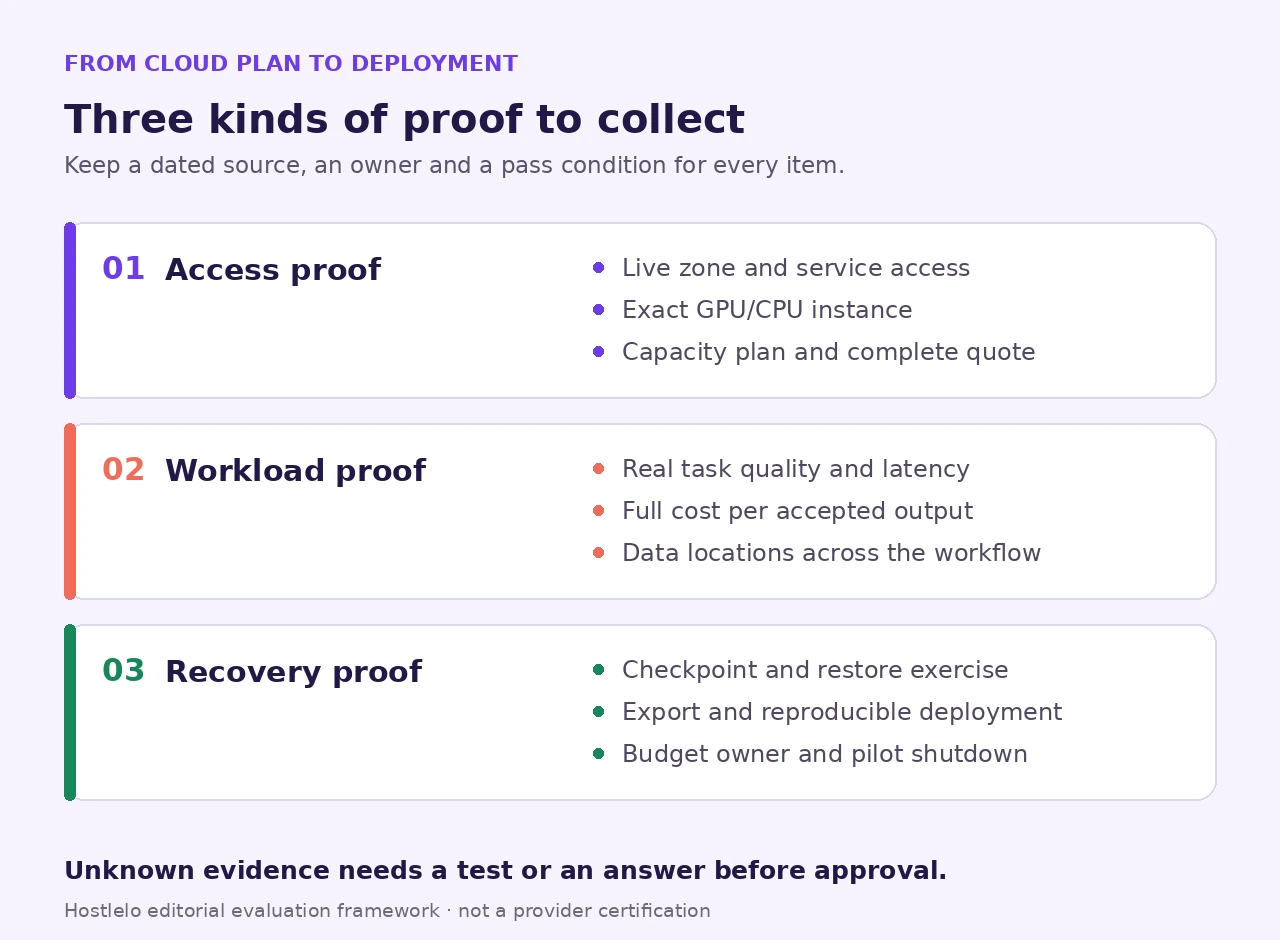
Mark missing evidence as unknown. An unknown is a task for the pilot or the provider, rather than a positive result.
This is an editorial framework for evaluating a deployment. It is not a CoreWeave certification or a claim that the planned Indian service already meets these requirements.
1. Confirm a provisionable region and zone
Ask for the exact region identifier, availability zone, supported services and earliest date on which your account can provision the required resources. Keep the answer with a timestamp.
A construction milestone, a sales conversation and a successful resource allocation are different pieces of evidence. Plan your release around the one your product actually needs.
CoreWeave's 30 September Vera Rubin release note describes limited availability in US-CENTRAL-09A and directs customers to request access. That existing offering has its own location and access conditions. Verify those conditions separately from the new India project.
For a pilot, record a resource identifier and a successful test-job timestamp. For a production commitment, obtain the relevant service order and availability conditions. Do not book a customer launch around a future campus date alone.
2. Check the whole instance, including CPU architecture
Write down the GPU model, GPU count per instance, memory per GPU, CPU architecture, system RAM, local storage and network fabric.
“Runs on NVIDIA GPUs” leaves several important questions unanswered. Your model may fit in memory while a required native library fails in the container. A distributed job may start while communication between workers prevents it meeting your deadline.
The Vera Rubin release note pairs Rubin GPUs with Vera Arm CPUs. For that platform, include an Arm-compatible container and native dependencies in the trial. Pin the tested image, runtime and model revision; a mutable image tag cannot identify the environment you successfully evaluated.
Use a representative task: your real context length, batch size, data loader and output constraints. Record peak memory, completion time and task correctness. A benchmark score for another model does not establish your application's behavior.
3. Separate capacity guidance from a reservation
Ask what is guaranteed under the selected plan, what can be interrupted, how capacity is allocated and what happens when your requested count is unavailable.
CoreWeave's Capacity Finder API currently evaluates Spot capacity. It is in beta, uses cached information and does not reserve nodes or guarantee successful provisioning.
The Spot Node Pools documentation describes preemptible resources suited to interruptible workloads. A ranking of promising zones is useful planning input, but your deployment still needs an allocation and an interruption strategy.
For a batch job, test resuming from a checkpoint. For an interactive service, establish a fallback before allowing interruption-prone capacity to carry the entire customer request path. Ask for the plan-specific terms instead of assuming that every resource option provides the same continuity.
4. Resolve GPU-hour versus instance-hour before estimating cost
A quote can price a GPU, a complete multi-GPU instance or a managed service. Put the billing unit next to every rate.
CoreWeave's public pricing page separates whole-instance pricing from single-GPU inference pricing. Its footnote limits the latter to inference-platform customers. Do not apply a single-GPU rate to an eight-GPU instance unless your actual offer permits that unit.
The following is illustrative arithmetic, using invented “cost units.” It is not CoreWeave pricing, an Indian tariff or a currency conversion.
Hypothetical quote | Resource used | Time | Compute calculation |
|---|---|---|---|
20 cost units per GPU-hour | 1 instance containing 8 GPUs | 10 hours | 20 × 8 × 10 = 1,600 cost units |
160 cost units per instance-hour | The same 8-GPU instance | 10 hours | 160 × 1 × 10 = 1,600 cost units |
Those two quotes describe the same compute expense. Multiplying the second one by eight again would overestimate the bill.
Build the full worksheet with these lines:
Cost line | Evidence to obtain |
|---|---|
Compute | Billing unit, allocated time, minimum duration, rounding and commitment |
Storage | Retained volume, tier, snapshots/checkpoints, operations and deletion rules |
Data movement | Charges on each provider's side and any private connectivity |
Supporting services | CPU resources, public IPs, monitoring and application infrastructure |
Commercial terms | Support, taxes, invoice currency, credit conditions and cancellation |
The pricing page reviewed for this guide lists free CoreWeave internet and internal data transfer. It does not determine charges imposed by a different provider holding your source dataset. Check both ends of a migration.
Measure cost per successful task during a pilot: total attributed trial cost divided by accepted outputs. Include billed idle periods and failed retries in the numerator. Keep task quality, input size and acceptance criteria constant when comparing offers.
5. Test latency from the route your customers will use
Measure from the application backend and the countries you serve. An India-only audience and a business serving India plus the UAE may produce different results over their real network routes.
Separate a transport check from a model test. A fast health endpoint says little about a long prompt waiting in a GPU queue.
For an endpoint you own or are authorized to test, replace the placeholder below with its real HTTPS health URL:
TEST_URL='https://your-ai-api.example/health'

curl --silent --show-error --output /dev/null \
  --connect-timeout 5 --max-time 20 \
  --write-out 'http=%{http_code} dns=%{time_namelookup} tls_done=%{time_appconnect} first_byte=%{time_starttransfer} total=%{time_total}\n' \
  "$TEST_URL"
The curl manual defines these times in seconds. They are cumulative milestones from the start of the request, so do not add the fields together. The first received byte can be an HTTP header; it is not necessarily a generated token. Inspect the HTTP status and curl's exit status too.
Then instrument a real model request for queue time, time to first generated token, output completion time and failure rate. Test representative load at different times and compare the slower tail of results, not just the best run. Record the sample count and concurrency so the figures are reproducible.
A nearby data center is a promising hypothesis for latency. The tested request path is the evidence. Our hosting latency guide explains the wider website checks.
6. Draw every path your data takes
Map more than the primary GPU. Include prompts, source files, model outputs, logs, traces, checkpoints, backups and support access.
Data component | Question to answer |
|---|---|
Request and response | Which service and location process them? |
Source dataset and retrieval store | Where do the original documents and indexes live? |
Logs and traces | Which observability systems receive their contents? |
Checkpoints and backups | Where are copies stored and how are they deleted? |
Support and control systems | Who can access them, under which policy and with which audit trail? |
Begin the pilot with synthetic or approved non-sensitive data. Reduce prompt content and avoid putting raw personal information into debug logs.
A local GPU address covers only one part of this map. Obtain the relevant data-handling terms and security evidence for the whole service. CoreWeave's Trust Center documentation points customers to privacy, resilience and audit materials. Match the requested evidence to your workload's requirements.
For a website connected to an external AI service, also review our AI-agent access and security guide. Application credentials and human permissions still need careful ownership.
7. Prove recovery across the failure boundary you care about
Ask the provider to identify the actual availability-zone and service failure boundaries. A count of buildings does not specify which networking, storage or control systems they share.
Write down your recovery time objective—how long the service may be unavailable—and your recovery point objective—how much recent work you can afford to lose. Make them concrete: for example, a customer support tool might require fallback responses immediately, while an overnight training job can tolerate a longer restart.
Run a controlled exercise on test resources:
- Save a checkpoint or a durable record of completed work.
- Stop a test worker and resume on the approved replacement.
- Verify that completed tasks are not repeated as new customer actions.
- Compare the recovered output and configuration with the expected state.
- Record elapsed recovery time and any lost work.
A second location can improve resilience only when the required model, data, credentials and resources can actually be restored there. A recovery design must also respect the data-location requirements recorded in check six.
CoreWeave's incident playbook identifies its status page as the primary incident and maintenance channel. Include relevant notifications and a named escalation owner in your operating plan.
8. Make the workload portable before a large commitment
Keep model artifacts, prompts, evaluation cases, application configuration and deployment instructions under your control. Document model licenses and any service-specific features you depend on.
CoreWeave publishes a Terraform provider for infrastructure such as CKS, networking, object storage and managed inference. It can help reproduce the CoreWeave environment. Moving to another provider still requires equivalent resources and adaptation of provider-specific configuration.
Perform a small export-and-restore trial. Check that the exported files are usable, that another approved environment can start the application and that its outputs meet the same acceptance tests.
For a normal website, keep the web application and its AI worker independently deployable. Your domain, customer database and billing flow should have an owner and recovery plan of their own. Our AI-powered hosting guide explains that operational split.
9. Define how the pilot stops
Assign a trial budget, a resource owner and an end time before provisioning. Set alerts, but also specify who will stop resources when an alert arrives. An alert alone does not cap a bill.
Use a bounded queue, a retry limit and an identifiable job ID. When work triggers a customer action, ensure that retrying the job cannot repeat the action accidentally. Track failures separately from accepted outputs.
At the end, follow the service's lifecycle rules for compute, volumes, snapshots, endpoints and IPs. Confirm which resources remain billable. Retain the approved evidence and backup you need before removing test data.
End with a dated decision: proceed, run another limited trial, or wait for a missing capability. Give each unresolved item an owner. That makes the outcome reviewable when the provider changes its offering.
A practical plan while the Indian project develops
Choose your first step according to the workload you actually have.
Your situation | Useful work now | Evidence to revisit later |
|---|---|---|
A small website using AI occasionally | Measure demand, protect server-held keys and compare an API with a dedicated worker | Whether dedicated capacity improves accepted-task cost |
A sustained inference service | Build a representative load test and compare service modes | Allocated capacity, latency distribution and complete quote |
A training or fine-tuning pipeline | Validate container architecture, checkpointing and storage throughput | Multi-node behavior and interruption/recovery results |
A workload with strict location requirements | Complete the data-flow map and evidence requirements | Service-specific locations, terms and recoverable capacity |
You can build this evidence using currently available, approved infrastructure. Re-run the same tests when a new service becomes accessible. A consistent evaluation is more useful than choosing a provider from a headline.
Research scope: Reviewed on 7 October 2026 against the public announcement and linked primary documentation. We did not provision an Indian CoreWeave region, obtain an India-specific commercial quote or run comparative GPU benchmarks. The proposed checks and arithmetic are a reusable evaluation method, not measured performance results.
Reader questions
When is CoreWeave's India project expected to become available?
The 7 October 2026 announcement targets mid-2028 for the first phase, with more capacity arriving in stages. Treat that as a project expectation and verify service-specific access before planning a deployment.
Can I use a US CoreWeave GPU price as an India quote?
Obtain a dated quote for the actual service, location and billing unit. Existing public pricing can help you identify cost categories, but it does not establish the commercial terms of the future Indian deployment.
Is a GPU-hour the same as an instance-hour?
A GPU-hour counts one GPU allocated for one hour. An instance-hour counts one complete instance for one hour; it can include multiple GPUs. Read the quote's unit before multiplying the rate.
Does Capacity Finder guarantee that GPUs will be available?
CoreWeave's current beta Capacity Finder evaluates Spot capacity using cached data. Its documentation says the results do not reserve nodes or guarantee that provisioning succeeds.
Will an India GPU cloud automatically make my AI application faster?
Measure your real request route, queue time, time to first generated token and completion time at representative load. Location alone does not establish application performance.
What should a small website do before renting dedicated GPUs?
Measure actual AI demand, accepted-task cost and operational requirements. Compare a hosted API, a managed service and dedicated compute using the same task-quality and latency criteria before committing.
Sources & further reading
- CoreWeave — India expansion announcement, 7 October 2026
- CoreWeave — Vera Rubin limited-availability release note
- CoreWeave — Capacity Finder API and its limits
- CoreWeave — Spot Node Pools
- CoreWeave — Cloud pricing and billing-unit footnotes
- curl — Official manual and timing variables
- CoreWeave — Trust Center documentation
- CoreWeave — Status and incident playbook
- CoreWeave — Terraform provider
What changed
Original guide tied to the 7 October CoreWeave India announcement. Reviewed primary documentation, distinguished future project dates from current access and added cost, latency, recovery and portability checks.
Originally published . About our editorial updates.