Wisdom Lens Review: Juber's Practical Toolkit for Better AI Judgment
Unverified completion claims, repeated mistakes, and unclear scope cost developers time. Juber's Wisdom Lens brings four inspectable AI skills to that workflow.
The short answer
Wisdom Lens is Juber's MIT-licensed instruction pack for AI-assisted work. Four skills cover verification habits, AI failure diagnostics, structured decisions, and practical operating principles. Its structural validator passed an independent run at the reviewed commit. Claude's two Stop hooks are model-evaluated prompt checks, and their effectiveness was not tested.

Reading options
On this page
- What is Wisdom Lens?
- Why this approach matters
- The four skills, explained
- How the pieces fit together
- What the hooks actually do
- Install it and try one focused task
- A real repository demo, with a clear boundary
- Where Wisdom Lens earns its place
- Limitations to understand before adopting it
- Verdict: start with one rule and inspect the result
- Visual credits
- Reader questions
- Sources & further reading
Before you start
A compatible agent host is required to load the skills. Review plugin contents and host permissions before installation. Node.js is needed to run the included structural validator; its reviewed source uses built-in modules. Keep independent tests and human release review in place.
Disclosure: This creator-led spotlight features Juber Shaikh's own open-source project. It combines public-source review with the bounded checks described below, rather than an independent customer endorsement.
AI development moves quickly. An assistant can draft a feature, suggest an architecture, and announce that the work is finished in one conversation. The difficult part is deciding whether the result deserves your trust.
Wisdom Lens, created by Juber through his CodeWithJuber GitHub account, addresses that moment. It packages practical decision frameworks, AI failure diagnostics, and working habits into skills that an agent can load when they are relevant. Its strongest idea is straightforward: make verification, clear scope, and honest uncertainty part of the workflow.
For developers, technical leads, and founders who already use AI assistants, that is an appealing proposition. You can inspect the actual instructions, adapt them to your team, and use the same material across supported hosts. There is no separate application backend to deploy.
This review examines the public source and documentation at commit 2e1e9e4, including the skills, agent definition, hooks, manifests, and validator. The package manifests identify version 1.2.1. An independent run of the package validator passed at this commit. Live AI output and prompt-hook effectiveness were not tested; those behaviors still depend on the host, its configuration, and the model.
What is Wisdom Lens?
Wisdom Lens is an instruction-only skill pack. The repository contains four skills, seven supporting reference documents, one advisor agent definition, two prompt-based response checks, and a small Node.js validation script.
The four skills share one directory. The Claude Code, Codex, and Kimi manifests point to that same material, avoiding separate copies that could drift apart. The README also documents an OpenClaw installation route, with an important compatibility qualification: OpenClaw detects the Claude prompt hooks but does not execute them.
The core package does not supply an MCP server, new executable agent tools, or credentials. Your existing assistant provides the model and tools. Wisdom Lens supplies guidance about how to use them. The included validator is a separate local development utility. Source: package overview and installation notes
Why this approach matters
Many frustrating AI workflows start with small judgment errors. A suggested dependency is accepted without checking that it exists. A feature grows beyond its agreed scope. An assistant repeats the same failing approach. A polished status message arrives without an inspectable result.
Wisdom Lens gives those situations names and suggests concrete responses. Ask for acceptance criteria before implementation. Check the source behind a consequential claim. Preserve a written handoff. Try a reversible experiment before making a large commitment.
The advantage is consistency. A team can refer to the same review habits during planning, implementation, and delivery. Those habits remain readable in ordinary Markdown, so adopting them does not require learning an elaborate configuration language.
Juber's creative contribution is the organization: broad ideas about judgment become named skills, diagnostic trees, short operating rules, and an advisor with a defined output format. That makes the material easier to apply to a real development session.
The four skills, explained
1. Builder Protocol: a useful starting point
The Builder Protocol contains twelve operating rules. They cover verification, measurable specifications, written state, standing instructions, inspectable deliverables, uncertainty, reuse, durable value, logging, trust, reflection, and attribution.
Several translate naturally into engineering practice. Before a feature begins, define the scope, budget, tolerances, and stopping conditions. Before accepting a completion claim, inspect the artifact or test result. Before inventing a new component, look for existing code and maintained documentation.
This is the easiest entry point because it can improve the shape of a single task. A request such as “clean up this module” becomes more useful when it includes a boundary on changed files, preserved behavior, and a test that defines success.
2. New Lens: diagnose a failing AI workflow
New Lens organizes sixteen chapters around machine, workflow, and relationship failures, followed by the human role in the process.
It covers repetitive loops, confident guessing, unnecessary reinvention, overcomplication, context loss, flattery, weak output, opaque systems, costs, and accountability. Its reference material turns several of those subjects into diagnostic trees.
For example, repeated unsuccessful actions trigger a recommendation to change the approach or restart from reliable context. Suspected hallucinations lead back to the original source. Growing complexity prompts a check on whether a teammate could understand and maintain the result.
That gives a developer a vocabulary for troubleshooting the collaboration itself. You can ask which failure pattern is occurring and choose a corrective action before spending another hour repeating the same prompt.
3. Decision Engine: turn uncertainty into a next step
The Decision Engine uses six stages: clarify, classify, diagnose, generate, decide, and act.
Its classification step is particularly practical. A familiar problem may need an established procedure. A complicated problem may need expert analysis. A complex situation may need a small experiment. A chaotic incident may need stabilization before deeper investigation.
The skill also asks for three genuinely different options, consistent evaluation criteria, consideration of existing commitments, and a low-cost probe before an irreversible move.
Consider a hosting migration. The options could be improving the current setup, piloting a new provider with one noncritical service, or planning a wider migration after measurements. Wisdom Lens can help structure that discussion. Engineers still need to supply real traffic data, costs, reliability requirements, and test results.
4. Wisdom Playbook: the people around the work
The Wisdom Playbook contains twenty chapters covering thinking, execution, leadership, communication, recovery, focus, and purpose.
This is relevant because software work includes reviews, disagreements, deadlines, and handoffs. The playbook encourages written requirements, consultation before a decision, checkable communication, honest credit, and repair after mistakes.
A technical lead could use it to prepare a calmer incident review or clarify a difficult implementation discussion. Its practical value comes from turning a general intention, such as communicating better, into a specific action someone can take.
How the pieces fit together
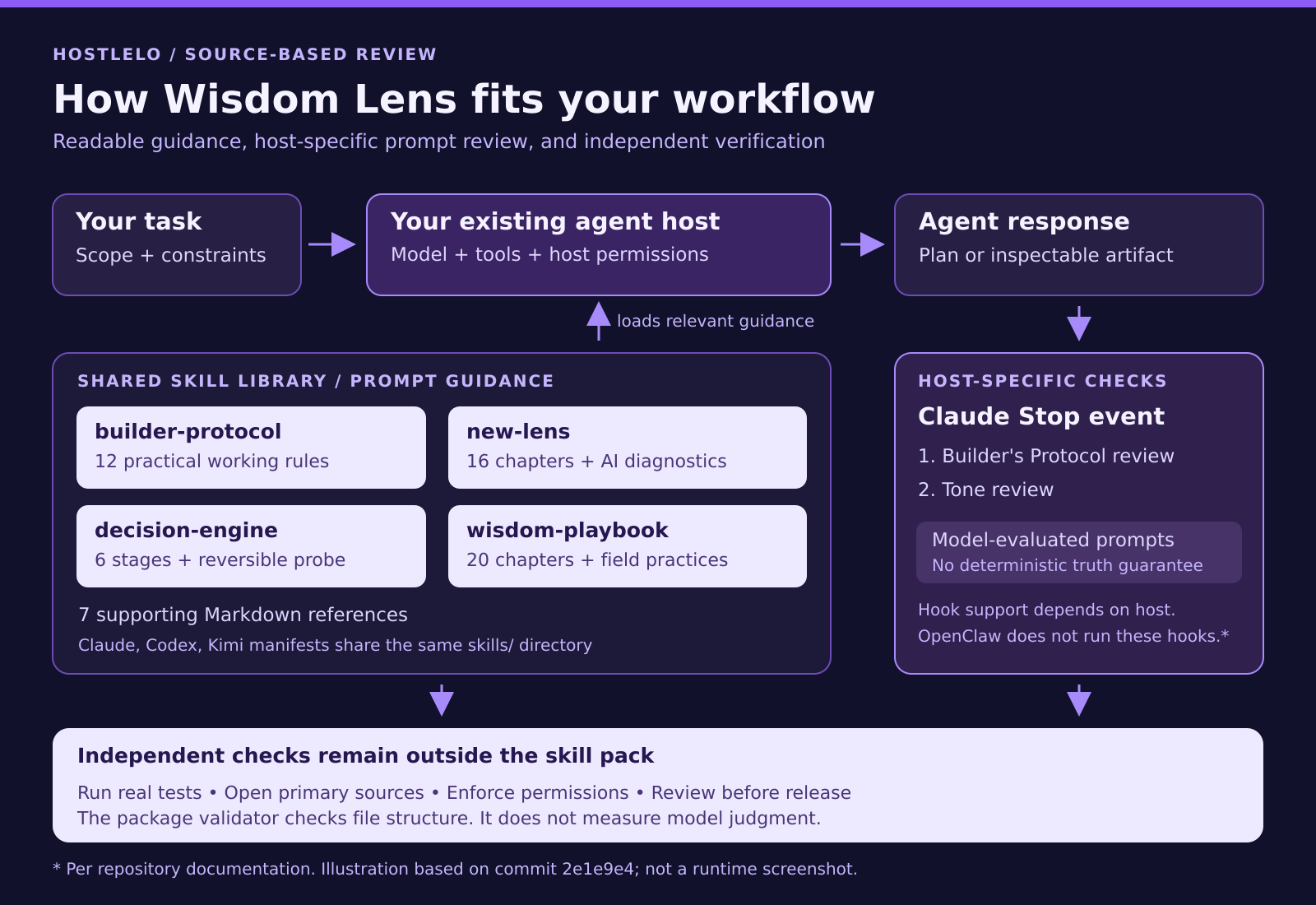
Architecture illustration based on the reviewed repository. Shared skills are portable content; hook execution is host-specific.
For complex situations, the repository includes a wisdom-advisor agent. Its definition inherits the model and lists Read, Grep, and Glob as its tools. It asks for a short diagnosis, relevant principles, and a small set of practical next steps.
The advisor offers a defined synthesis role. Its declared tool list is read-oriented; it does not itself define deployment or modification tools. Its availability and operation depend on the host loading that agent definition.
What the hooks actually do
The hook configuration defines two prompt handlers for Claude's Stop event.
The first asks about verification, measurable criteria, lasting usefulness, uncertainty, and attribution. The second asks for direct communication, appropriate depth, and considered handling of tense conversations.
These are model-evaluated checks. Claude Code's documentation explains that prompt hooks send the configured prompt and event input to a model, then process its structured decision. The trigger is tied to a lifecycle event; the judgment still comes from a model. Official hook documentation
This distinction matters. The repository does not implement a deterministic fact-checker, a test runner inside these hooks, or a security boundary that blocks every unsafe action. A prompt review can reinforce useful behavior, but factual accuracy, permission controls, and release approval need independent evidence and safeguards.
Install it and try one focused task
For Claude Code, the repository documents these commands inside a session:
/plugin marketplace add CodeWithJuber/wisdomlens
/plugin install wisdom-lens@wisdom-lens
Start a new session after installation, then try:
Using the builder-protocol skill, review my implementation plan.
Identify missing acceptance criteria, claims that need verification,
and the smallest inspectable result. Keep the agreed scope unchanged.
This command pattern is consistent with Claude Code's documented marketplace workflow. Installation still requires a compatible host and any permissions your environment requires. Official plugin installation guide
For other hosts, follow the repository's current instructions:
- Codex uses the repository's
.codex-plugin/plugin.json, which points toskills/ - Kimi Code CLI documents
/plugins install https://github.com/CodeWithJuber/wisdomlens, followed by/reload - OpenClaw documents
openclaw plugins install https://github.com/CodeWithJuber/wisdomlens --accept-capabilities, after reviewing the bundle and the capabilities being accepted
These are documented installation routes, rather than a claim that every host combination has been independently tested for this review. In particular, do not assume Claude's hooks or advisor operate identically elsewhere. Repository installation details
A real repository demo, with a clear boundary
The repository includes a maintainer-published GIF of its validation command:

Repository demonstration: checking skill packaging, manifests, and references. This recording does not measure decision quality or prove that a host's hooks fired.
The command is:
node scripts/validate.mjsWe independently reran this command at the reviewed commit, and it passed. That fresh run checked the package structure; it did not exercise a live AI session or establish that the prompt hooks improve answers. The GIF above remains the maintainer's recording.
Reading the validator source shows exactly what it checks: skill names and descriptions, directory-name agreement, linked relative resources, three package manifests, JSON parsing, and exclusion of specifically named private-memory files and directories.
It uses Node's built-in filesystem, path, and URL modules. The script defines no network calls, subprocess execution, or file writes. Its private-memory check is a filename/path rule, so it should not be mistaken for comprehensive secret scanning.
This is a useful engineering detail. The package has a repeatable structural check that contributors can inspect and rerun. A passing result confirms those structural rules, not the truth of every statement in the skill content.
Where Wisdom Lens earns its place
Wisdom Lens is worth trying when you already have a capable assistant but want clearer habits around its output.
For solo developers, start with task scope and evidence for completion. For teams, use the same checklist in implementation plans and review notes. For founders, use the decision loop to make options and uncertainties explicit. For maintainers, the readable source provides a starting point for a project-specific working guide.
The most persuasive advantages are visible in the repository:
- Four focused entry points let you choose the guidance relevant to the task
- Reference files provide concrete practices beyond short slogans
- One shared skill tree keeps the packaged content consistent
- The advisor and prompt checks give compatible hosts additional ways to apply it
- The MIT license permits reuse and modification subject to its notice requirements
The license identifies Zubair Shaikh as the copyright holder and includes the standard warranty disclaimer.
Limitations to understand before adopting it
The instructions remain dependent on model behavior. They add context and, where prompt hooks run, additional model work. The repository provides no benchmark establishing a particular productivity gain, hallucination reduction, or cost saving.
Some reference material includes research statistics and broad claims about AI. This review does not treat those figures as independently verified findings or as evidence of Wisdom Lens's effectiveness.
The rules also need contextual judgment. Advice to exceed a specification should be interpreted as quality within an agreed boundary, particularly when another rule warns against adding scope. Numerical heuristics and general leadership guidance should fit the actual situation.
Finally, the README explicitly describes the frameworks as an author-created operational synthesis. It does not provide source mappings sufficient to verify every principle against older texts. Treat it as practical authorial guidance, and use qualified advice for consequential professional or personal matters. Provenance and safety statement
Verdict: start with one rule and inspect the result
Wisdom Lens shows Juber's skill at turning an abstract problem, better judgment around AI, into a compact and inspectable developer resource. Its value lies in the questions and practices it brings into a workflow: what is verified, what defines done, what could fail, and what evidence will survive the conversation?
Start with Builder Protocol on a small task. Ask for measurable acceptance criteria, an inspectable deliverable, and clear uncertainty. Then judge the result against your own tests and review standards.
Explore the Wisdom Lens repository, read the skills, and adapt the useful parts. If they improve your work, give Juber feedback, share a concrete example, or star the project so other builders can find it.
Visual credits
The cover is an AI-generated editorial illustration, not application UI. The architecture diagram is an original source-based explanation. The GIF is the maintainer's package-validator recording; it does not measure AI judgment. Demo source; copyright 2026 Zubair Shaikh, MIT license.
Reader questions
What does Wisdom Lens add to an AI assistant?
It adds four instruction skills, supporting reference material, an advisor definition, and two Claude Stop prompt checks. The existing host supplies the model and tools. The package does not provide a separate application backend or a new underlying model.
Does Wisdom Lens guarantee factual or safe output?
No. Its prompt checks are evaluated by a model. Real tests, source verification, host permissions, and human review remain necessary. This review did not validate live AI performance or prompt-hook effectiveness.
Which hosts does the repository document?
The repository provides manifests for Claude Code, Codex, and Kimi, all pointing to the same skill directory. It also documents an OpenClaw route and explicitly states that OpenClaw does not execute the Claude prompt hooks. These routes were reviewed in the source; every host combination was not independently tested.
What did the independent validator run prove?
The command node scripts/validate.mjs passed at commit 2e1e9e4c30223ec1f98ef6e565ae90f2d3400a8b. It checks skill metadata, package manifests, relative references, JSON parsing, and named private-memory paths. It does not validate every factual claim, scan all secrets, or measure model judgment.
Can I adapt the skills for my own projects?
The repository uses the MIT license, which permits reuse and modification subject to its copyright and license notice requirements. Review the license and adapt the guidance to your actual project constraints.
Was this guide helpful?
Help us make the next update better.
Sources & further reading
- Wisdom Lens: reviewed source snapshot
- Wisdom Lens installation and provenance notes
- Builder Protocol skill
- New Lens skill
- Decision Engine skill
- Wisdom Playbook skill
- Claude Stop prompt hook configuration
- Package validator source
- MIT license
- Official Claude prompt hook documentation
- Official Claude plugin installation documentation
What changed
Reviewed public source at commit 2e1e9e4c30223ec1f98ef6e565ae90f2d3400a8b. The structural validator passed an independent run. No live AI output or prompt-hook effectiveness was tested. The embedded GIF is the maintainer-published demonstration.
Originally published . About our editorial updates.