Search Console TXT Verification:Find the Right DNS Zone and Fix Failures
Verify your domain in Google Search Console, check the TXT record at authoritative DNS, and fix wrong-zone, hostname and caching problems without touching website or email records.

On this page
- Choose the property you actually need
- Start by finding the active DNS zone
- Copy the value from Search Console
- Add one record without disturbing existing services
- Check authoritative DNS before clicking Verify
- Diagnose the result instead of guessing
- Keep verified ownership through DNS moves
- Verification is a starting point for SEO
- Keep a small verification record
- Reader questions
- Sources & further reading
The short answer
For a Search Console Domain property, add the exact Google verification TXT value at the DNS provider serving your domain, then click Verify. Check the record name and authoritative answers before blaming propagation. Keep the record after verification; ownership verification does not guarantee indexing or rankings.
Before you start
Access to the intended Google account and the authoritative DNS zone; a copy of existing DNS records; the exact token from Search Console. These steps add one TXT record and do not require changing nameservers.
A TXT record can look perfect in a hosting dashboard and still be invisible to Google. The usual explanation is surprisingly ordinary: the record was added to a DNS zone that the internet is not using.
To verify a domain in Google Search Console, add Google's exact verification value at the active DNS provider and complete verification in Search Console. This guide gives you a way to prove each step, rather than repeatedly clicking Verify and hoping.
The instructions were checked against the linked official documentation on 12 October 2026. Examples use reserved example domains and dummy tokens; replace them with your own values.
Choose the property you actually need
A Domain property, such as example.com, covers that domain across protocols and its subdomains. A property for shop.example.com covers that subdomain and its descendants, not the parent domain.
A URL-prefix property, such as https://www.example.com/, has narrower scope. It can be useful when your responsibilities cover a particular site rather than the whole domain.
Google's ownership verification guide documents DNS verification for Domain properties. TXT is the common manual route, but Google can also offer CNAME or an integrated DNS-provider flow. Follow the method shown for your property.
Do not change working DNS arrangements merely to use this tutorial. If an agency or IT team controls the zone, give them the exact record request.
Start by finding the active DNS zone
Your registrar, web host and DNS provider can be three different companies. Buying the domain at one company does not mean that company's DNS editor serves it.
On macOS or Linux, inspect the nameservers:
dig NS example.com +shortOn Windows:
nslookup -type=NS example.comUse these names as a clue to the active provider. Cloudflare names often identify Cloudflare; hosting providers can use branded or custom names. A name alone is not proof that a particular dashboard belongs to the active zone.
Confirm the provider and account with whoever manages the domain. For advanced setups, including delegated subdomains and secondary DNS, identify the zone serving the exact name you are verifying.
If the public nameservers belong to Cloudflare while you add TXT in an unused cPanel zone, waiting will not make that cPanel record public. Our domain connection guide explains the difference between changing nameservers and editing records.
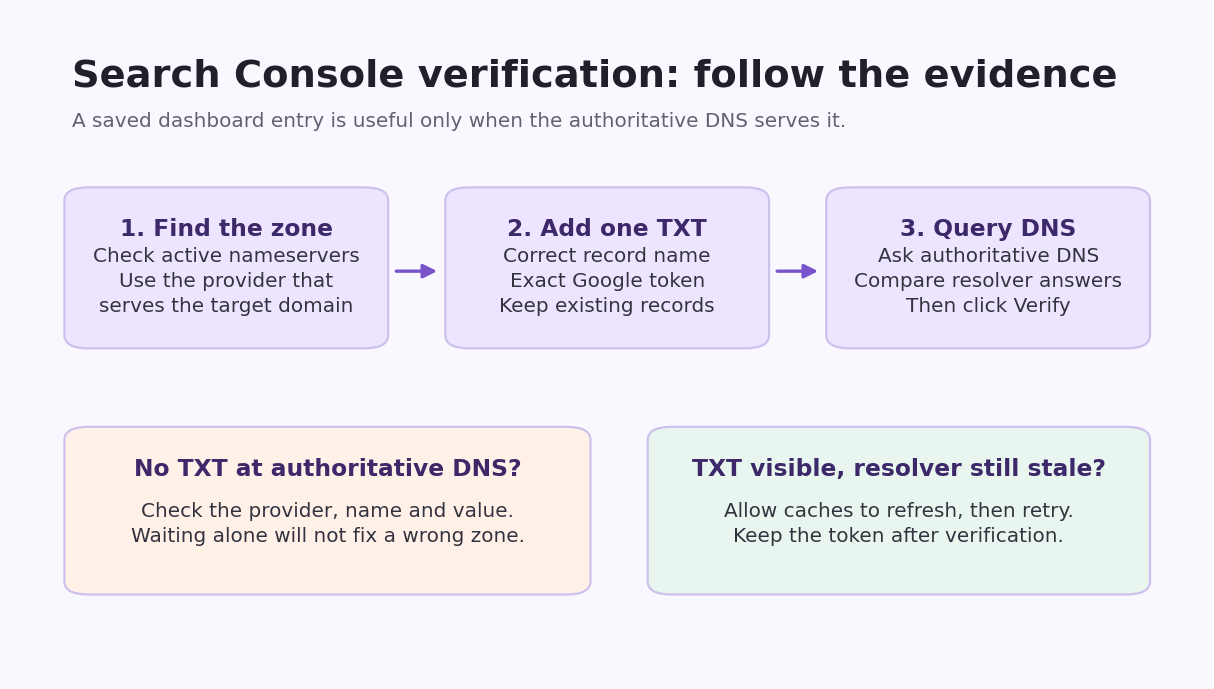
*Original Hostlelo checklist: follow the evidence from the active zone to Google's verification result.*
Copy the value from Search Console
In Search Console, add a property, choose Domain, and enter the domain without a scheme or path. For the whole domain, enter example.com, not https://example.com/about/.
When the manual flow offers TXT, copy the complete value. A dummy example is:
google-site-verification=REPLACE_WITH_YOUR_TOKENThe prefix is part of the value. Do not copy this example into your zone; it cannot verify your property.
Keep the verification screen open. Also note which Google account and property generated the token. Finding someone else's Google token in DNS does not mean your account has been verified.
Add one record without disturbing existing services
The intended record is a TXT value at the domain being verified. Keep existing A, AAAA, MX, SPF, DKIM, DMARC and other verification records.
A record specification you can hand to the DNS administrator is:
Domain to verify: example.com
Type: TXT
Name: the root of example.com, using this provider's name syntax
Value: the exact google-site-verification= value from Search Console
TTL: provider default unless your DNS administrator specifies otherwise
Provider forms differ. A root name might be @, blank, or the fully qualified domain. Do not treat these entries as interchangeable in every panel.
In Cloudflare
Use the zone that actually serves the domain. Open DNS > Records, select Add record, choose TXT, enter @ for the root, paste the value, and save.
TXT records do not use the orange-cloud proxy switch used by certain address records. You do not need to pause Cloudflare or change the website's proxy status to publish this TXT record.
If the domain is managed through a hosting partner, follow that partner's supported record-management route. See Cloudflare's DNS record instructions.
In cPanel
Open Domains > Zone Editor, choose Manage for the domain, add a TXT record, and enter its name and value.
For the root, the fully qualified name example.com. is an explicit zone name; the final dot denotes an absolute DNS name. Follow the form's validation and confirm the saved row names the root domain. Do not assume that @ is accepted by every cPanel form.
Check the result before saving. A provider that automatically appends the domain can turn a poorly entered name into example.com.example.com.
The cPanel Zone Editor documentation explains record management and warns that record text can accept invalid data. Reset DNS Zone is not a verification troubleshooting step.
At another provider
Use that provider's documented root-name convention. If you cannot identify the correct field, send the record specification to support rather than changing unrelated entries.
Multiple independent TXT records can coexist at the same name. Keep the Google verification value separate from SPF and from another owner's verification value.
Check authoritative DNS before clicking Verify
A saved record proves that the dashboard accepted your change. A DNS answer proves that a server is serving it. Google's success screen proves that Google accepted the verification.
Start with a normal lookup:
dig TXT example.comThen query an actual authoritative nameserver returned for your domain. Replace the example server below:
dig @ns1.provider.example example.com TXT +norecurseInspect the response status and answer. An authoritative response normally includes the aa flag. Compare the TXT value with Search Console, including the complete token.
If your domain uses several authoritative nameservers, check them all. One correct answer and one stale or missing answer can produce inconsistent results.
Finally compare a public resolver:
dig @1.1.1.1 example.com TXTOn Windows, a similar explicit-server check is:
nslookup -type=TXT example.com 1.1.1.1These command forms are documented by BIND and Microsoft.
Quotes displayed around TXT output are normal presentation. Compare the actual value; avoid adding extra quote characters or line breaks inside the saved token.
Diagnose the result instead of guessing
No token at the authoritative server: revisit the provider, zone, record name and value. The record may not be saved or may have been entered under the wrong name.
Token visible at one nameserver only: ask the provider to check zone publication or secondary synchronization. Do not assume the zone is healthy from one answer.
All authoritative answers are correct, but a resolver is stale: allow cached answers to refresh. Earlier negative answers can also be cached. Reducing the TTL after a resolver cached an older answer does not erase that cache.
SERVFAIL, timeout or another DNS error: look at the full output. These are not the same as a valid answer without your TXT record. Have the DNS administrator inspect delegation, DNSSEC and server reachability; disabling DNSSEC blindly can create a different problem.
Google says the value does not match: re-copy the token for the intended account and property. Check for missing characters, extra whitespace and a different owner's token.
Google advises that manually published records can sometimes take two or three days to become available. That is a possible provider/publication delay, not a reason to ignore a wrong zone. Our DNS propagation guide explains caching in more detail.
Once the answers look correct, return to Search Console and click Verify.
Keep verified ownership through DNS moves
Record the property, authorized owner and purpose in your internal DNS inventory. Copy needed verification records when moving to a new DNS provider.
Keep tokens for owners who should retain verified access. When a staff member or agency leaves, review their Search Console permissions and their verification tokens together. Removing a user in one screen may not be enough if they still control a verification method.
Have another authorized business owner with an appropriate independent verification arrangement where practical. Protect the Google and DNS accounts with strong authentication. The public TXT token is not a password; control of the accounts and zone is what matters.
Verification is a starting point for SEO
A successful verification does not force Google to crawl, index or rank your pages. After verification, inspect an important URL, check that it is accessible and indexable, and submit the appropriate sitemap.
Resolve real access, canonical and indexing problems before expecting performance data to tell a useful story. There is no guaranteed first-page result from adding a TXT record.
Keep a small verification record
Write down the property, record name, DNS provider, date, authoritative answers and the Google account that completed verification. That short note makes the next migration or access handover much easier.
If support needs to investigate, provide those details and the observed DNS error. Never send them your Google password or DNS login credentials.
Reader questions
Can I verify a Domain property with an HTML tag?
A Domain property uses DNS verification. HTML files and meta tags are options for URL-prefix properties, whose scope is narrower. Google may offer TXT, CNAME or an integrated provider flow.
Should I put the TXT record in cPanel or Cloudflare?
Use the DNS zone that serves the domain publicly. Check active nameservers and confirm the record through authoritative DNS. A cPanel zone can exist without being the active public zone.
Can I remove the TXT record after verification?
Keep a verification record while its owner should retain verified access. When removing an owner, review that person's verification tokens separately and preserve tokens belonging to authorized owners.
Does a verification TXT record interfere with SPF?
An additional TXT record can coexist with SPF and other verification records. Add a separate record; do not replace the SPF value or combine both services into one string.
Why does dig show the token but Google still fails?
Check that the token is exact and belongs to the intended account and property, that every authoritative nameserver agrees, and that public resolvers return it. DNS errors or cached answers can also affect verification.
Will verification get my website to the top of Google?
No. It establishes access to Search Console data and tools. Crawling, indexing and ranking depend on separate requirements; verification alone does not guarantee any of them.
Sources & further reading
What changed
Rewritten with authoritative-DNS checks, explicit provider-specific record names, TXT/CNAME scope, owner-token retention guidance, honest indexing limits and an original diagnostic visual.
Originally published . About our editorial updates.